Two estranged martial artists reunite for a global fighting tournament in Street Fighter, opening in Prague and cinemas worldwide this weekend. Director Kitao Sakurai‘s colorful adaptation of Capcom’s video game franchise gets off to an engaging start, with appealing leads, energetic fight choreography and an infectious dose of 1990s nostalgia. But an increasingly incoherent story and endless climax ultimately knock it out, leaving even the much-maligned 1994 Jean-Claude Van Damme movie with one considerable advantage.
Street Fighter opens with a stylish anime-inspired prologue that traces the relationship between Ryu (Andrew Koji), Ken Masters (Noah Centineo) and their martial arts mentor Gouken (Don Lee). At a 1987 fighting championship, Ryu emerges victorious but begins to tap into a dangerous supernatural power, setting the stage for a tragedy that drives the two friends apart.
The animation is terrific, capturing the exaggerated physicality and fantastical mythology of the games in a medium ideally suited to both. Indeed, these sequences suggest that a fully animated Street Fighter movie might have been the best approach to the material, particularly when the more outlandish elements become difficult to reconcile with live-action filmmaking.
But the live-action portions initially work well, too. By 1993, Ryu has abandoned fighting to operate a noodle truck in New York City, while Ken has embraced the lifestyle of a wealthy Los Angeles playboy. Neither has entirely escaped his past, and both are eventually drawn into another World Warrior Tournament, organized by the sinister M. Bison (David Dastmalchian).
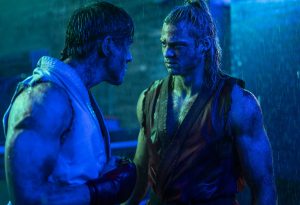
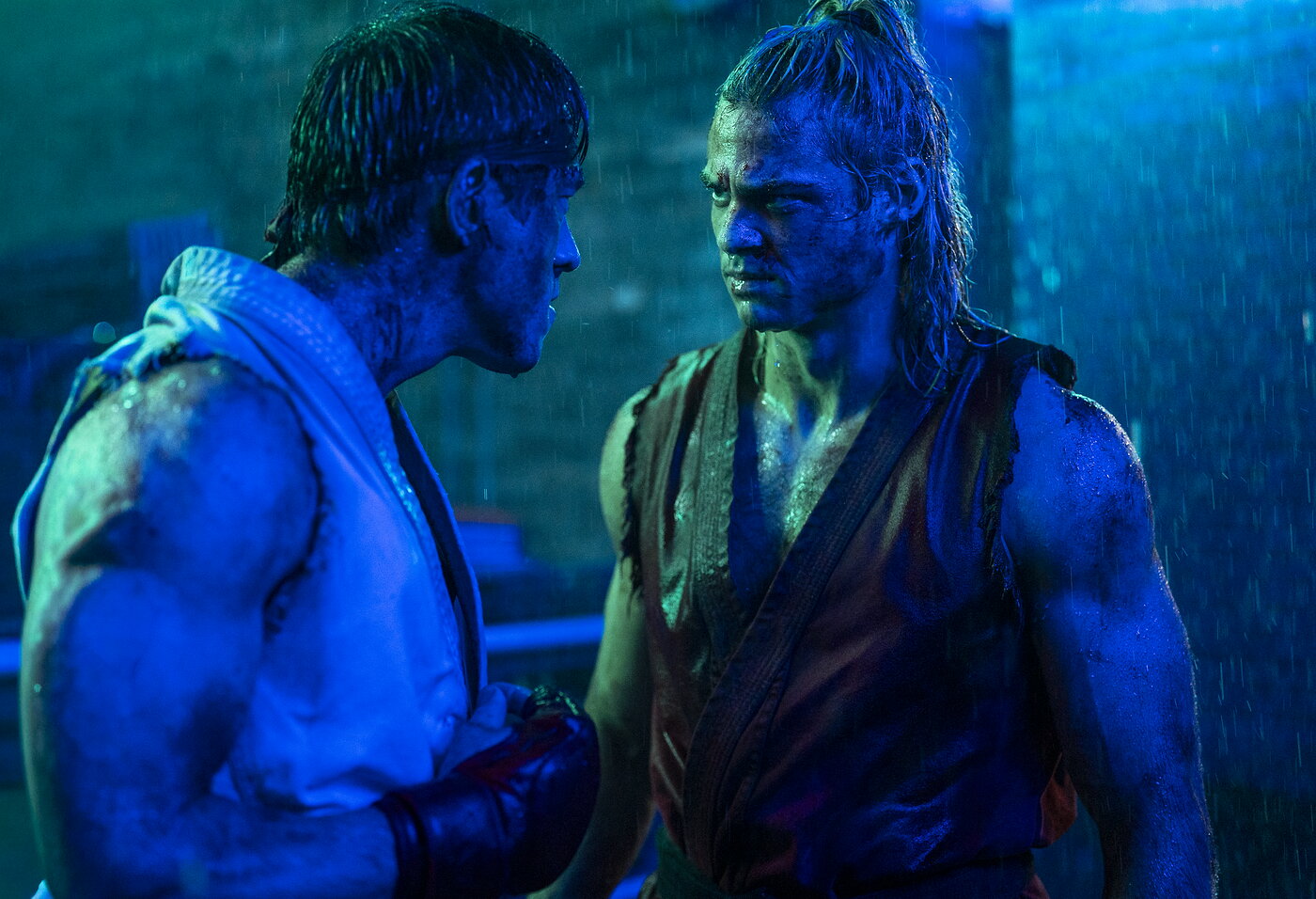
Koji and Centineo are well matched, fully committing to their cartoonish characters while giving them enough recognizable human flaws to make their relationship engaging. Ryu’s withdrawn seriousness contrasts nicely with Ken’s carefree arrogance, and their first confrontation, in which Ken attacks while Ryu stubbornly refuses to fight back, is among the movie’s best fight sequences.
For a while, Sakurai seems to have found the right balance between affectionate parody and genuine character drama. These aren’t particularly complicated people, but they’re likable enough that we want to see them overcome their differences and rediscover the friendship they lost.
The movie goes all-in on its early-’90s setting, packing the soundtrack with period hits and recreating the costumes, environments and signature moves of the games with considerable enthusiasm. Familiar characters and stages appear throughout, and even the memorable bonus round involving the destruction of a car makes an appearance. Longtime fans will certainly appreciate the attention to detail, which is considerably more faithful to the games than the 1994 adaptation. Sakurai understands the appeal of this universe, and the film’s opening stretch makes a convincing case that its absurdities can work on the big screen.
Unfortunately, things begin to unravel with the introduction of Bison. Dastmalchian is a terrific character actor, but he’s badly miscast as the imposing villain, lacking the larger-than-life screen presence necessary to dominate this particular world. Worse, the screenplay has him directly reference iconic lines delivered by Raul Julia in the earlier movie, inviting a comparison that does him no favors.
Bison wants to extract Ryu’s mysterious power to enhance his own abilities, but to what end? World domination? Personal revenge? Winning a fighting tournament? The movie never establishes a compelling objective, leaving its central villain pursuing vaguely defined supernatural energy for reasons that remain frustratingly abstract.
The tournament is designed to lure Ryu out of hiding, which it accomplishes, but the surrounding competition increasingly feels like an afterthought. The colorful fighters are introduced, exchange a few blows and largely disappear into the background, their individual motivations rarely extending beyond the costumes and special moves that identify them.
Some exceptions: Cody Rhodes makes an entertaining Guile, Vidyut Jammwal has fun as Dhalsim, and Eric André brings welcome chaotic energy as the outrageous ring announcer. It’s also amusing to see Joe (Alex Volkanovski), the largely forgotten opponent from the original Street Fighter game, emerge as a surprisingly formidable tournament competitor.
Chun-Li (Callina Liang) receives a more substantial storyline, but it’s scarcely more convincing. Seeking revenge against Bison for murdering her father, she joins the FBI, gets assigned to his case, infiltrates his organization and earns his trust before abruptly outing herself and failing to accomplish much of anything. The movie loses nothing by excising the half-hour dedicated to her story.
Meanwhile, Akuma (Joe Anoa’i) somehow emerges from the film’s poorly explained supernatural mythology, bringing another formidable fighter into the equation without clarifying what he actually wants. Jason Momoa‘s Blanka is similarly underwhelming, realized through CGI the filmmakers seem embarrassed to display onscreen for more than a few seconds at a time. Practical effects would have gone a long way to selling this character better.
The fighting itself starts out impressively, with clearly staged martial arts sequences that allow the performers’ physical abilities to shine. But as supernatural powers increasingly dominate the action, the fundamental appeal of hand-to-hand combat begins to evaporate. Why bother throwing a punch when you can simply conjure a fireball? There’s nothing inherently wrong with incorporating the games’ signature abilities, but Sakurai never establishes convincing rules for how they operate.
By the time Ryu’s central predicament is effectively resolved around the 75-minute mark, Street Fighter has exhausted most of its narrative momentum. Unfortunately, there’s still roughly three-quarters of an hour to go What follows is an increasingly chaotic procession of fights and supernatural confrontations in which the characters’ objectives become almost impossible to follow. Who wants what? Why are these people fighting each other? What precisely will happen if the villains succeed?
This year’s Mortal Kombat II and Masters of the Universe encountered similar problems balancing nostalgia, fantasy mythology and blockbuster spectacle, and Street Fighter initially seemed better positioned to succeed with the strong focus on its two central characters. That makes the collapse all the more disappointing. What begins as a surprisingly charming celebration of arcade-era gaming ultimately becomes an exhausting showcase of familiar characters fighting for reasons the movie can’t adequately explain.